The Factory That Left More Than an Empty Shelf
APSF’s rise, its reported shutdown, and the uncomfortable difference between replacing a watch and replacing the people who made it possible.
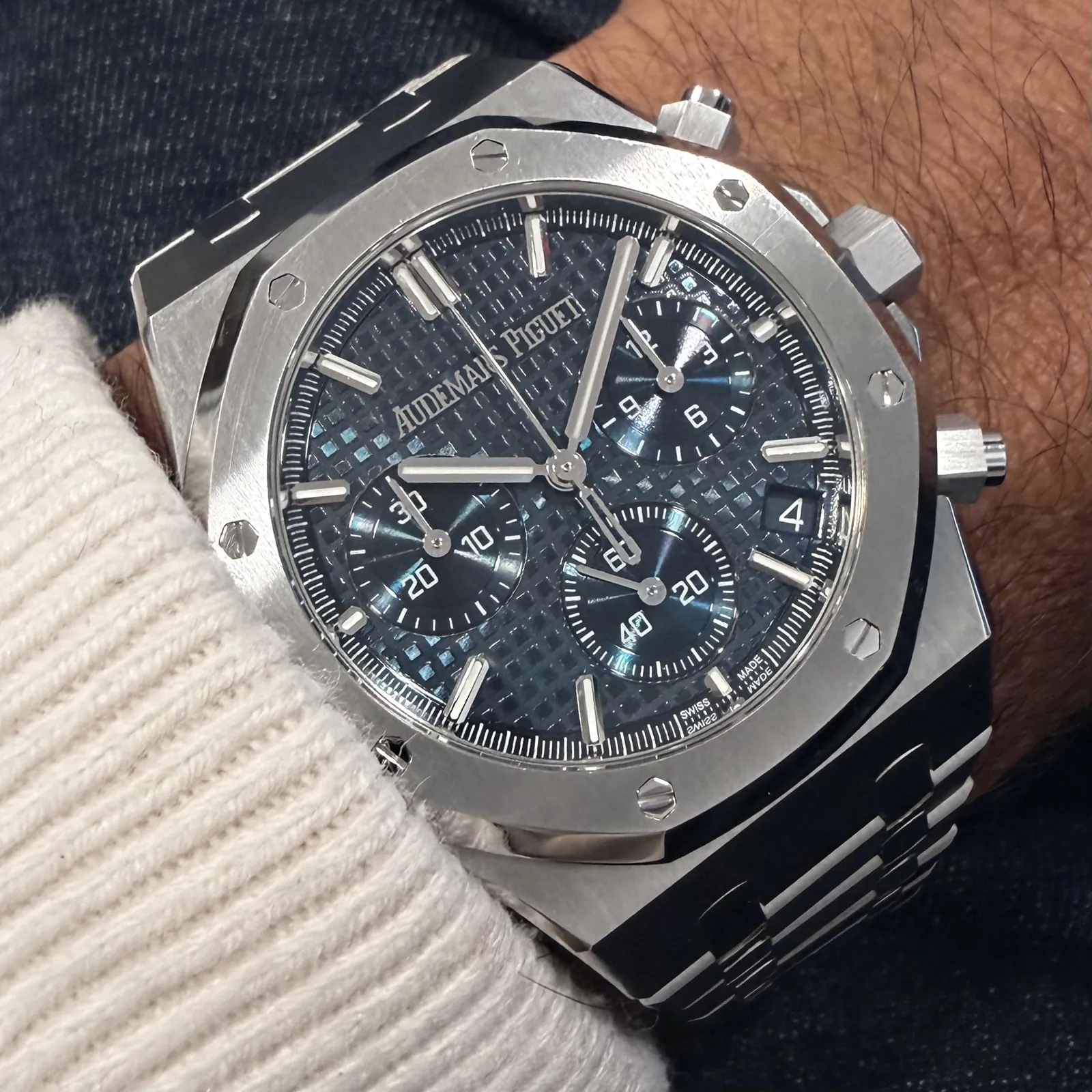
The words “last available piece” do extraordinary things to a collector’s judgment.
A watch can spend six months sitting quietly on a wish list, somewhere between an expensive strap and a sensible decision. Then its factory reportedly gets raided. Suddenly the watch is essential. The dial has historical importance. The movement represents an era. The purchase requires immediate attention, preferably before breakfast.
In May 2026, APS Factory (APSF) became the subject of precisely that kind of attention. Reports of a raid spread through the replica trade, orders became uncertain, and buyers began searching for remaining inventory. Watches that had recently been ordinary purchases acquired the emotional weight of artifacts.
The details of the reported enforcement action remain difficult to establish independently. So does the full extent of any subsequent recovery. What became clear was the disruption—and how many different corners of the hobby felt it.
For collectors of Royal Oak and Code 11.59 replicas, APSF had become an unusually consequential name. Its importance extended beyond a good Royal Oak dial or a convincing bracelet. It had helped make mechanically ambitious watches available in forms that enthusiasts could take seriously.
When its supply became uncertain, the question was larger than where to buy the next Royal Oak.
It was whether the industry could replace the breadth of work behind it.
The difficult watch
To understand APSF’s place in the market, start with the object that helped build its reputation.
The Royal Oak is an unforgiving design. Its broad brushed surfaces and polished bevels leave very little room for vague interpretation. The bezel, case, end links, and bracelet form a continuous sequence. A mistake in one part changes how the next part looks.
A conventional round case can conceal a little awkwardness. An integrated bracelet tends to advertise it.
The dial creates its own problems. Tapisserie has depth and structure; it is more than a collection of squares. The size of the pattern, the definition of its edges, and its response to light influence the entire watch. A plausible blue under one lamp can become an entirely different proposition outdoors.
Then the owner turns the watch over.
An exhibition caseback makes mechanical architecture part of the design. The bridges, rotor, and balance occupy visible positions. A generic movement beneath a decorative cover may suggest the right picture, but it does not necessarily give the watch the right dimensions, behavior, or construction.
That was the opportunity APSF pursued. Dedicated clone movements could improve several things at once: the layout beneath the caseback, the position of the date, and the proportions surrounding them. The movement became part of the solution to the whole watch.
For a replica manufacturer, that is an important change in ambition. It requires more than finding a better shade of blue.
What APSF built
There is no tidy public corporate history of APSF. Accounts of its beginnings and supplier relationships are incomplete, and the word “factory” itself deserves care. In this trade, a familiar name may bring together development, financing, component sourcing, finishing, and assembly without owning every stage.
We should resist filling those gaps with a heroic founder story. The watches provide firmer ground.
The 15400 and 15500 Royal Oaks became important parts of APSF’s identity, associated with dedicated clones of the 3120 and 4302 movement families. These projects helped move the conversation beyond surface resemblance. Enthusiasts could argue about actual architecture and function as well as decoration.
The more consequential development was the breadth that followed. APSF became associated with smaller Royal Oaks, chronographs, Offshore models, Divers, ceramic executions, and Code 11.59 references. The 4401 clone chronograph platform extended that mechanical ambition across different watches.
Those watches did not all serve the same customer. Someone attracted to a compact Royal Oak was asking for a different experience from someone buying a large Offshore chronograph. A Code 11.59 owner had chosen a design that much of the watch world was still busy arguing about.
APSF gave those interests somewhere to go.
That breadth is easy to undervalue while everything is available. A catalog looks like a menu. Only when supply falters do the individual dishes reveal how much preparation they required.
Ambition had its limits
None of this made APSF flawless.
An impressive movement design and a consistently well-assembled watch are separate achievements. A clone caliber can be technically interesting while the finished piece still needs attention. Dial alignment, bracelet edges, lubrication, and final inspection remain stubbornly physical tasks. Reputation does not perform them.
This is where nostalgia can become misleading. After a shutdown, collectors tend to remember the breakthrough and forgive the inconvenience. A watch that once needed regulation becomes “a classic.” An awkward bracelet becomes “part of its character.”
We can appreciate APSF without granting it a retrospective exemption from quality control.
Its significance was the range of difficult problems it attempted and the credible results it sometimes produced. It was never a promise that every watch carrying its name would arrive ready to embarrass Switzerland.
That distinction matters even more when surviving stock acquires a premium. Scarcity changes availability. It does not improve assembly.
The shutdown without a clean ending
Public discussion of the reported raid became visible in mid-May. Dealers and collectors described disrupted orders, uncertain deliveries, and searches for stock. Some buyers reportedly received watches already moving through the distribution chain. Others found the piece they wanted had become difficult to source.
That unevenness is part of the story.
A production disruption does not make every finished watch disappear simultaneously. A dealer may still hold inventory. A shipment may already be in transit. Other components may exist somewhere further back in the chain.
Consequently, a watch appearing after the reported raid cannot, by itself, tell us whether ordinary production has resumed.
By summer, examples described as APSF were still appearing in transactions and quality-control posts. Rumors of a return circulated too. Those sightings establish continued availability of at least some watches under the name. They do not establish the condition of the organization behind it.
As of October, the responsible conclusion remains narrower than either “gone forever” or “fully back.” The disruption is widely reported in trade accounts; the exact operating status remains opaque.
That is less satisfying than a dramatic ending. It is also closer to how this market works.
What a factory name can hide
Collectors use factory names as shortcuts. They help organize a market that otherwise demands an unreasonable amount of homework.
But the shortcut becomes less reliable when production is interrupted.
The name on a listing does not reveal when the watch was assembled, which movement version it contains, or how consistently its components were finished. Even a sincere seller may have limited visibility further up the chain.
The problem is not that every post-disruption watch should be treated with suspicion. It is that the label carries less information than buyers sometimes give it credit for.
The deeper question is continuity. A competitor may gain access to a familiar movement without reproducing the case, bracelet, or final inspection that once surrounded it. Another may produce a better-finished exterior around a less ambitious mechanism. Neither outcome is impossible. Neither amounts to inheriting an entire factory’s capabilities.
This is our reading of APSF’s aftermath: a product-development operation is harder to replace than its most recognizable part.
You can photograph a movement. The coordination required to deliver it inside a convincing finished watch is far more difficult to put in an album.
The popular watches will find company
The commercial logic favors the Royal Oak.
Its demand is visible. Its design is instantly recognizable. Buyers already understand why they want one. For a rival deciding where to invest, a mainstream Royal Oak offers a clearer proposition than an unusual reference whose admirers can fit around a modest dinner table.
That does not make the mainstream watch easy to reproduce. It makes the effort easier to justify.
The consequence is likely to be an uneven recovery across the category. Competition can develop around popular time-and-date models while more specialized watches remain dependent on older stock or less complete alternatives.
This is why a replacement Royal Oak does not settle the APSF question. It may satisfy a large group of buyers and still leave a chronograph enthusiast or Code 11.59 collector without an equivalent answer.
The commercial center can recover before the edges do.
Those edges matter. They are where a catalog becomes interesting rather than merely successful.
The Code problem
Code 11.59 makes the point particularly well.
It has never enjoyed the Royal Oak’s immediate consensus. Its case architecture, crystal, and dial ask for closer attention. The design gives a replica producer several difficult relationships to reproduce without offering the same automatic recognition in return.
For a factory allocating money and production capacity, that is an awkward invitation.
APSF’s involvement gave enthusiasts a route into the collection, including mechanically ambitious chronographs. The importance of that work becomes clearer when we ask who has an incentive to reproduce the full range again.
Demand may exist without being large enough to make the project an obvious priority. A technically interesting product can remain commercially inconvenient.
Our concern is therefore about variety as much as quality. If the industry rebuilds around its safest sellers, collectors may gain stronger mainstream choices while losing some of the peculiar references that made the hobby rewarding.
There will always be another familiar sports watch. The stranger corner of the catalog has to persuade someone to care.
Collecting after the panic
APSF’s disruption also revealed something about the buyers.
We like to believe our decisions are governed by proportions, finishing, and mechanical merit. Then supply becomes uncertain and availability starts doing the thinking.
A genuine appreciation of a discontinued build can be perfectly reasonable. Some watches offer a combination of design and mechanism that is difficult to replace. But “hard to find” and “worth owning” remain separate judgments.
Existing owners have another concern: keeping the watch running. A sophisticated clone movement brings pleasure when it works and a more specialized repair problem when it does not. Continued access to knowledgeable watchmakers and suitable parts matters more than the final few arguments about a factory’s reputation.
For prospective buyers, the useful response is patience and attention to the particular watch. For owners, it is a little practical care before a problem turns urgent.
Neither approach supplies the thrill of securing the alleged final example. Both tend to age better.
What remains
APSF may return more visibly. Its supply relationships may continue in forms that are difficult for outsiders to identify. Competitors may make some of its achievements ordinary, then improve on them.
We should welcome that possibility without pretending it has already happened.
The legacy is substantial enough without a premature obituary. APSF helped expand what collectors could expect from a Royal Oak or Code 11.59 replica: more convincing movement architecture, more demanding complications, and a wider range of watches worth discussing.
Its reported shutdown exposed how fragile that progress can be. Demand survives. Expertise, coordination, and dependable production do not necessarily reassemble themselves around it.
That is why the most revealing question is no longer which factory deserves the crown. It is which watches will remain possible when the market has finished reorganizing.
The Royal Oak will attract attention. It always does.
We will be watching the rest of the catalog.