VSF Daytona 116508 “John Mayer”: The Gold Standard Is Complicated
A deep look at the green dial, the DD4130, and the compromises hiding beneath all that yellow gold.
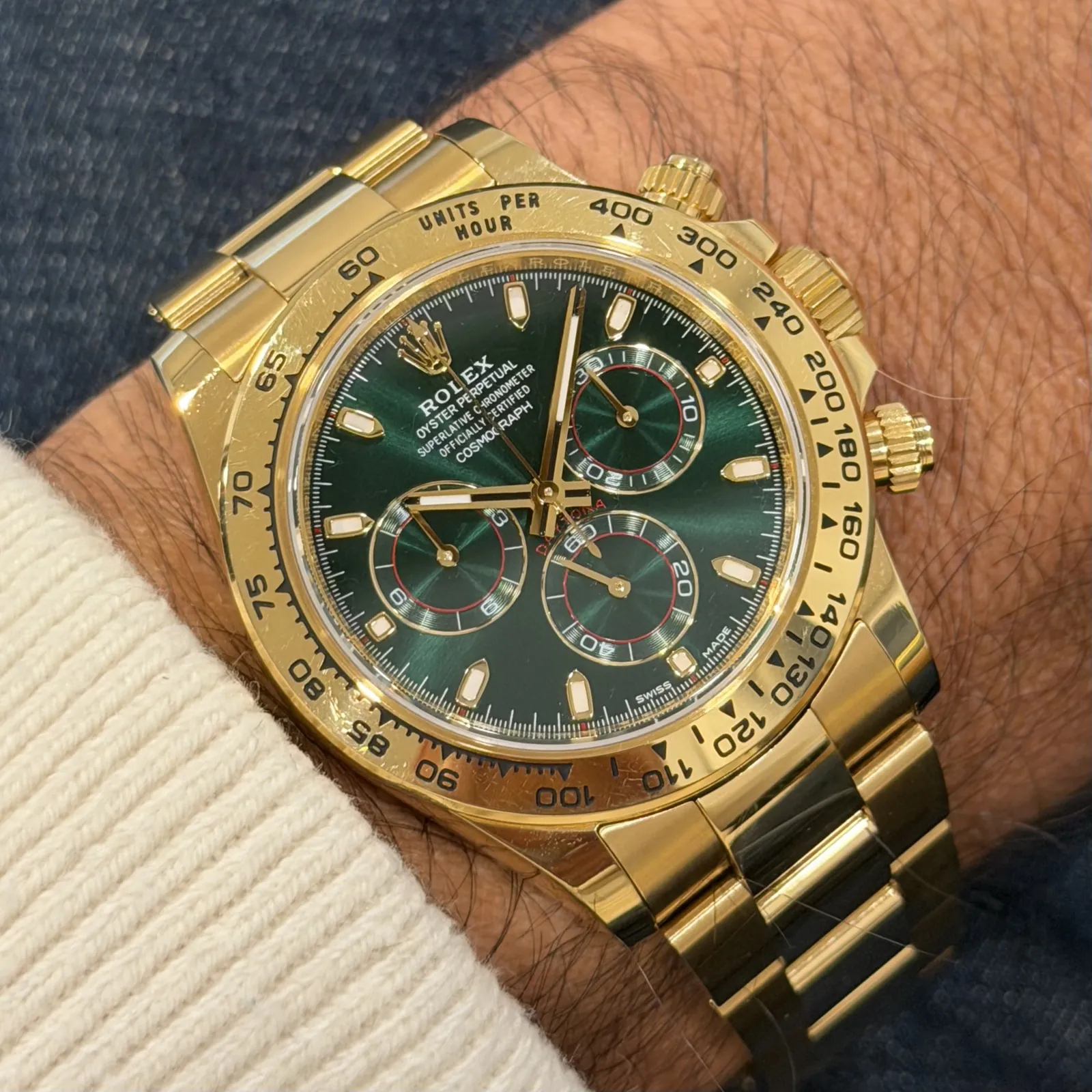
Some watches disappear under a cuff. This one would like a table near the window.
The yellow-gold Daytona with a green dial has a peculiar confidence. The case is bright. The bracelet is bright. The bezel contributes another polished surface, apparently concerned that the first two might be exercising restraint. Then the green dial pulls everything together, giving all that gold somewhere to go.
That is the appeal of the 116508. It is also the challenge of reproducing it. Getting the lettering right is useful. Getting the relationship between the colors right is essential.
VSF’s DD4130 version is a serious attempt at the whole package: the older Daytona proportions, a functioning clone chronograph, a sunburst green dial, and—in the heavier configuration examined here—more substance than the earlier lightweight builds. It deserves consideration. It also deserves a more demanding assessment than a flattering photograph and the word “perfect.”
Our view: the approximately 180 g VSF is a compelling starting point for someone who wants the original green-and-gold Daytona. Its strongest argument is the combination of appearance, proportions, and movement. Its unresolved argument is the gold itself.
Before the nickname became the watch
The green-dial 116508 arrived in 2016. Its rise to collector shorthand followed John Mayer’s public enthusiasm in 2019. “John Mayer” is a nickname, not an official edition or a collaboration.
There is something wonderfully familiar about the sequence. A watch sits in the catalog. Someone with taste and an audience points at it. Suddenly everyone discovers that they have always loved it.
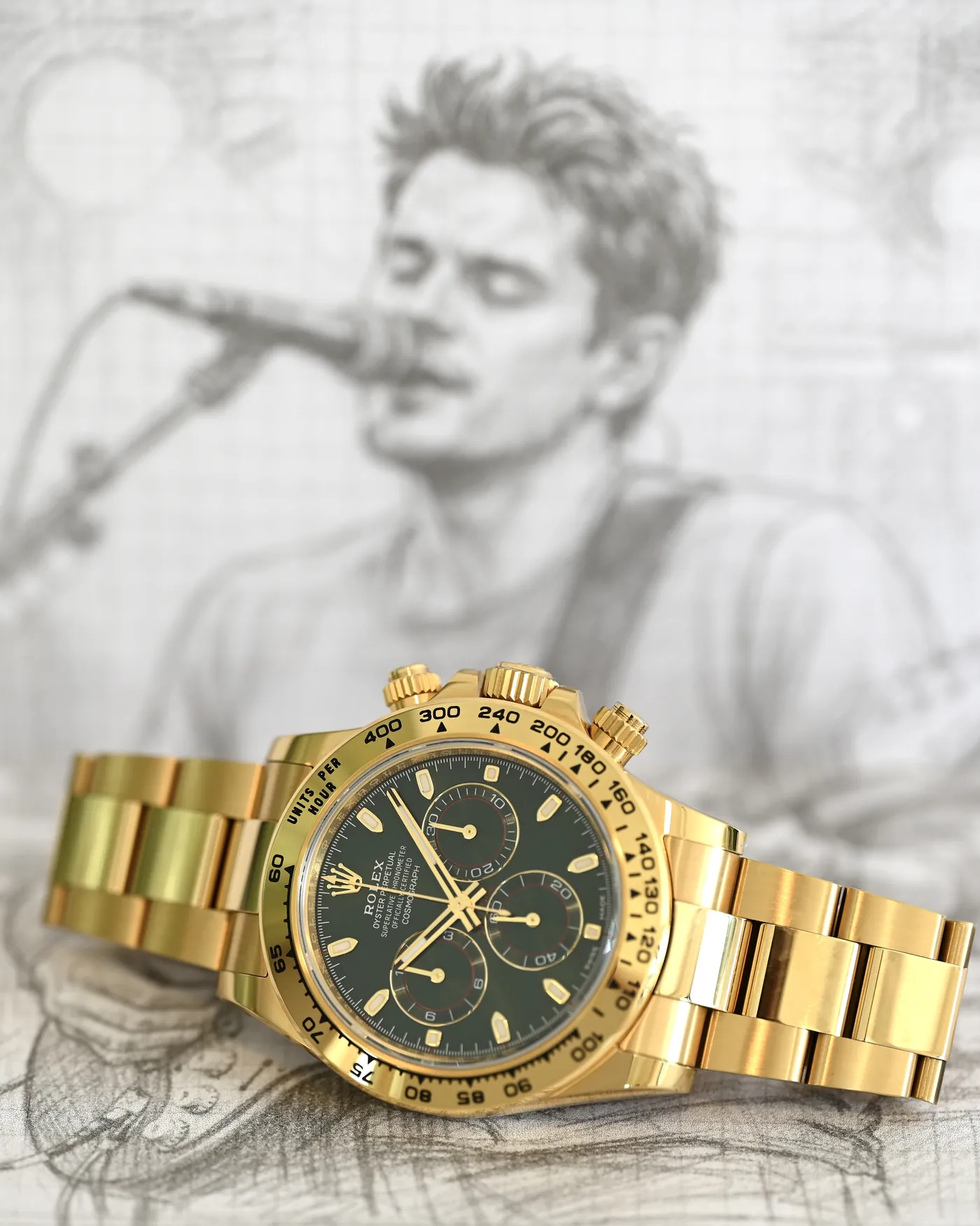
Still, the design earns the attention. The green extends across the main dial and the three recessed registers, while the gold subdial surrounds and small red accents interrupt that continuity. The result is more cohesive than a conventional contrasting-subdial chronograph. It can look dark and densely colored in subdued light, then become much more metallic as the sunburst catches illumination.
The polished gold tachymeter bezel is equally important. A black ceramic ring would give the dial a firm visual boundary. This bezel lets the gold flow outward into the case and bracelet. It makes the watch feel like one continuous object, with the green dial held inside it.
This review concerns the 116508 with the DD4130, not the later 126508 or a different movement sold under similar language. That distinction matters before we discuss a single upgrade.
Which VSF are we actually talking about?
“VSF John Mayer” is an incomplete description.
Lightweight and increased-weight examples coexist, and version numbers have been applied inconsistently. A watch described as V2 in one place may occupy similar territory to a V3 elsewhere. A newer listing does not necessarily establish a newer physical build.
For this assessment, the target is the heavier, approximately 179–181 g configuration with the Dandong 4130 clone. Those are example weights, not a guarantee for every watch. Bracelet sizing changes the result, and a scale reading without the link count tells only part of the story.
The sensible buying question is therefore quite specific: Is this the heavier 116508 build, what movement is actually inside it, and what does this particular example look like?
A version sticker cannot answer all three.
The dial: where the watch earns its personality
The challenge is not simply producing a green dial. It is producing green with movement in it.
A sunburst finish creates directional reflections. Rotate the watch and the brightness changes across the surface. On this design, that gives the dial depth without needing a different texture or a contrasting color in every register.
VSF captures that essential behavior. The visible radial finish and green registers preserve the broad character of the original. This is the part of the watch that makes someone stop scrolling, and it has more to do with the way light crosses the dial than the number of words printed at twelve.
Where judgment becomes more difficult is the exact green. Brightness, saturation, and the warmth of the surrounding gold all influence the result. A photograph taken beside a window can make the same watch look markedly different from one photographed beneath warm indoor lighting. Automatic white balance adds another opinion nobody requested.
We would not call the color exact on that evidence. We would call it persuasive enough to make this configuration worth examining closely.
The subdial surrounds deserve particular attention. Their width and definition help organize a busy face. Too thin and the dial loses some of its structure; too heavy and the registers become three conspicuous targets. VSF’s execution retains the substantial rings that make this reference recognizable.
Printing and applied furniture need a separate assessment. The coronet, luminous markers, minute track, red Daytona signature, and register scales all occupy very little space. Misalignment can disturb the whole dial even when each component is acceptable by itself. Inspect them together in a straight-on photograph, then look again at ordinary viewing size. A dial can survive a microscope and still look wrong. The reverse happens too.
Hands, lume, and a chronograph that should do its job
The Daytona uses slim luminous hour and minute hands. Their job is already difficult: they must remain readable over a dial containing three registers, several scales, and a small publishing business above the center.
The large central seconds hand belongs to the chronograph. Ordinary running seconds sit at six, elapsed minutes at three, and elapsed hours at nine. That layout matters when checking the watch. A stationary central hand is normal when the chronograph is stopped.
Hand installation is more consequential than a tiny cosmetic imperfection along an edge. The hands need clearance from one another, the dial, and the crystal. The chronograph must start, stop, and return cleanly to zero. A hand that occasionally hangs up is a functional fault, however beautiful the rest of the watch may be.
The luminous material adds practicality after dark, but this is a small-marker chronograph. Lume brightness immediately after charging tells little about how useful it remains later. Without controlled comparison, claims of genuine-equivalent brightness or duration are enthusiasm dressed as measurement.
We would prioritize clean installation, legibility, and correct reset over a photograph of an especially energetic blue glow.
The gold: improved does not mean settled
Here is the difficult part.
The original watch is made from 18K yellow gold. The VSF reproduces its appearance with a surface coating over other materials. Those are fundamentally different constructions, with different implications for weight, wear, repair, and refinishing.
The heavier VSF generation has attracted praise for a less aggressive yellow than earlier examples. It has also attracted criticism for remaining too yellow. Both reactions exist, and photographs do not resolve the disagreement.
Our position is straightforward: the finish can look attractive without being an exact match for the genuine watch’s gold.
Look at the relationship between components. The bezel, crown, pushers, case, links, and clasp should belong to the same watch. Some variation in apparent brightness comes from brushing and polishing. A distinct color mismatch between adjacent parts is another matter.
Claims about the coating’s chemistry, actual gold content, or thickness require evidence beyond its appearance. “PVD,” “18K plated,” and “wrapped” should not be treated as interchangeable descriptions. Nor does an 18K or 750 marking establish that a replica component is solid gold.
Durability is the other unanswered question. Initial finish quality and long-term coating life are separate subjects. Clasp edges, bracelet contact points, and the underside of the watch experience repeated friction. A few clean weeks cannot tell us what several years will do there.
That makes ownership slightly different from owning an uncoated steel Daytona. Aggressive polishing can remove material from the finish you are trying to preserve. Replating may improve an unsatisfactory color, but it adds expense and introduces another craftsperson’s work into the result.
We would buy the best-looking stock example available and assess it in person before commissioning that work. Sending a watch for refinishing before deciding whether you dislike its finish is an impressively efficient way to spend money twice.
Case and bezel: preserve the shape
The older Daytona’s compactness is part of its appeal. A nominal 40 mm measurement does not mean every case surface measures exactly 40 mm, and different caliper positions can produce different readings. Diameter alone also says little about how the lugs, caseback, and bracelet settle on a wrist.
The heavier VSF aims to retain the approximately 12 mm profile rather than acquiring an obviously swollen case. That is a sensible priority. Added mass is a poor trade if it changes the silhouette that made the watch desirable.
For visual assessment, look along the case sides and lug tops. Reflections reveal waviness and softened transitions more readily than a flat photograph. Crown guards and pusher placement contribute to the profile too; these should be considered as an assembly rather than scored as isolated details.
The tachymeter is engraved into a gold-colored metal bezel. The scale’s dark infill must remain crisp, with consistent numerals and markers. Its alignment should make sense against the dial. Because the bezel is a large polished ring, scratches and imperfect finishing can draw attention quickly.
Underneath, replicated hallmarks and engravings contribute to completeness, but they sit well below shape and finish in our priorities. A beautifully rendered hallmark cannot rescue a clumsy lug.
Crystal and rehaut: clarity before upgrades
Crystal clarity changes how the entire dial is perceived. Reflections can wash out the green, obscure printing, or make the face appear less immediate. The crystal’s edge and seating also affect the profile.
That makes the crystal worth inspecting. It does not make replacement compulsory.
Compare the actual watch in diffuse daylight and indoor light before deciding it needs an aftermarket crystal. A replacement may offer a useful improvement on a particular example. It may also introduce installation risk and fresh questions about sealing.
The engraved rehaut is another familiar collector diversion. Alignment, finish, and cleanliness matter, especially if a defect is obvious without magnification. Beyond that, decide how much attention the detail deserves in daily use. There is a difference between enjoying a watch and conducting a disciplinary hearing for an engraving.
DD4130: a substantial reason to choose this build
The movement is one of the clearest reasons to take this version seriously.
The DD4130 belongs to the established family of clone movements reproducing the genuine calibre 4130’s integrated chronograph architecture. The important features are functional: automatic winding, the correct register arrangement, and a column-wheel chronograph with a vertical clutch.
The column wheel coordinates the chronograph’s switching functions. The clutch connects the timing mechanism to the running movement. The appeal is that this is a dedicated chronograph construction, supporting the Daytona’s function and relatively slim packaging.
It is still a clone. The standard DD4130’s regulated balance differs from the genuine movement’s free-sprung system. A similar layout does not establish identical alloys, manufacturing tolerances, lubrication, shock resistance, or quality control.
That distinction should inform expectations without obscuring the achievement. A functioning integrated automatic chronograph in this package is meaningful. It makes the watch more satisfying than an exterior imitation whose complications only decorate the dial.
The genuine 4130’s approximately 72-hour reserve is a useful reference point. It is not a certified specification for every DD4130. Reserve must be measured on the actual watch, from a consistent starting condition. Timing it with the chronograph running is also a different test from timing it with the chronograph stopped.
Daily accuracy deserves the same discipline. A good timegrapher reading in one position is encouraging, but it does not establish performance across positions or on the wrist. Amplitude and beat error add useful information, provided the setup is appropriate. None of those readings proves that a movement is clean and correctly lubricated throughout.
We regard the DD4130 as a strong reason to prefer this configuration. We do not regard it as an exemption from mechanical inspection.
Crown, pushers, and sensible ownership
Threads should engage cleanly. The crown should wind and set the movement without obvious roughness, skipping, or an erratic change in resistance. Screw-down pusher collars should release and secure without force.
Operate the chronograph deliberately: start, stop, then reset. This is not a flyback chronograph. Repeated starts and resets should leave the hands consistently aligned, including after the elapsed-minute counter has advanced.
An unpleasant noise, intermittent reset, or hand that creeps when it should remain still deserves investigation. “They all do that” is not a diagnosis.
Water resistance belongs to the individual assembled watch. Screw-down fittings do not certify it. Have the watch pressure-tested before deciding how to use it around water, and repeat the assessment after work that affects its seals.
Servicing is another practical consideration. Find a watchmaker willing to work on this movement before a fault makes the search urgent. Familiar architecture helps, but access to suitable parts and competent labor still varies. Repairs can consume a meaningful share of the purchase price.
Bracelet, clasp, and the limits of the scale
The Oyster-style bracelet supplies a large portion of the visual effect. Brushed outer links control the shine; polished center links carry it along the wrist. Consistency between those finishes matters more than how dramatic they look under a dealer’s spotlight.
Check articulation, screw heads, end-link fit, and the clasp’s closure. The bracelet should move freely without links binding. The safety lock should secure positively. Test the fitted example’s extension mechanism too, rather than assuming the presence of a familiar clasp shape guarantees correct operation.
Approximately 180 g gives the heavier VSF more substance than lighter examples, but it does not reproduce solid gold’s material character. The often-quoted genuine comparison is roughly 200–205 g; bracelet length must be matched before treating the difference as meaningful.
Mass distribution matters as well. Weight concentrated in the head behaves differently from weight distributed through the bracelet. A heavier watch can feel less settled if its fit is poor. A lighter one can be more comfortable while remaining less faithful to the original in hand.
Our preference is to preserve the case shape and bracelet articulation before chasing the last few grams. The scale is one instrument. It should not be the editor.
Where the alternatives fit
Older Clean and original ARF examples retain collector interest for their dial or gold-tone execution. Heavier ZF and other builds address the desire for more mass. Their existence keeps VSF’s strengths in perspective: no single specification settles this reference.
We would avoid a universal factory ranking without equivalent current examples under the same lighting. Historical comparisons remain useful, but they cannot establish the condition, authenticity, movement, or availability of a watch offered today.
For a new purchase, our preferred starting point is the heavier VSF with a verified DD4130 and a convincing dial and finish. Someone who already owns a satisfying older build has less reason to change. Someone whose overriding priority is the closest possible gold tone needs a direct material comparison before accepting any factory’s reputation as an answer.
What we would check before accepting one
The most useful inspection focuses on this configuration’s actual risks:
- Identity: confirm 116508, DD4130, and the intended heavier build. Ask for a scale photograph with the bracelet configuration stated.
- Color: request neutral daylight images and a short moving video. Assess the dial and the consistency of the gold-colored components together.
- Dial assembly: inspect marker alignment, printing, hand clearance, and cleanliness beneath the crystal.
- Chronograph: watch a full start, stop, and reset sequence, including advancement of the elapsed-minute counter.
- Exterior and fit: examine bezel engraving, crown and pusher threads, bracelet movement, screws, and clasp security.
- Mechanical condition: review timing information in context; arrange further inspection or pressure testing where needed.
Price should follow that configuration and condition. An old review’s invoice does not establish today’s fair price, particularly when servicing or aftermarket work is included. Compare equivalent watches and keep any proposed upgrades in the total.
The Repinkee verdict
The VSF DD4130 “John Mayer” works because it preserves the reasons to want a 116508: the continuous gold exterior, the green dial’s shifting light, and the compact proportions of a proper automatic chronograph.
The heavier configuration makes that proposition more complete. The DD4130 gives it mechanical substance. Neither achievement settles the coating’s accuracy or longevity, and neither turns a replica into a solid-gold watch.
We would choose a clean, well-assembled example, verify the movement, and live with the stock finish before changing anything. Prioritize the dial and the whole watch’s color over a version number. Prioritize comfortable proportions over a heroic scale reading.
This is a good choice for the collector who wants the original green-and-gold design and understands what a coated watch asks of its owner. The collector who needs the material experience of solid gold will keep noticing what is missing.
For everyone else, there is plenty here to enjoy. Preferably near a window.